houston, we’ve got a problem with space solar

Stars are the power plants of the universe and inside their nuclear furnaces everything element from helium to iron is forged and as they burn, they illuminate the cosmos. Our star alone emits a stunning 384 yottawatts every second, which is more energy than we’d know what to do with. Hence the big idea behind solar power. If we capture even a little but of the solar energy radiating in some spot of the world every minute of every day, it would be a cheap and plentiful way to keep energy grids humming with electricity. But even though it’s hard to argue with the proposition for solar power becoming the dominant energy source in the future with improved photovoltaic technology and economies of scale, there are still two major problems with relying on the Sun for all our energy needs. Solar power is ultimately intermittent since our planet rotates, and we loose a great deal of potential energy as it’s diffused by our atmosphere. To counter those challenges, space solar was born.
Ok, maybe born is a little too grandiose of a term for the concept which would put solar panels into vast orbital arrays which always face the Sun and channel the energy they collect down to Earth. By using already existent photovoltaic and satellite technology, space solar startups say that they’ll be able to quickly and easily deploy space borne solar farms and slowly but surely help feed the massive energy grids across the world. And if we consider the proposition, it looks pretty solid and highly feasible at first glance. However, when we give these claims a closer, more skeptical look, we find a number of problems. The main concern, and a potential show stopper, is actually getting all that energy down to Earth. Just as solar energy dissipates in the atmosphere so would beams from orbiting solar panels. Since the Sun is a ball of plasma over a million kilometers across, it still delivers enough light and heat to brightly illuminate a hemisphere and create deserts. The beam from an array of satellites, even very massive and powerful ones, won’t be anywhere near as powerful as the Sun and deliver only a tiny portion of what it actually collects in orbit.
Space solar companies say they will be using technology borrowed from communication satellites so all that energy can be beamed down without creating a multi-megawatt laser. But that translates to a few milliwatt per square centimeter being used to deliver what have to be megawatts of energy. To keep transmissions at safe levels comparable to radio waves and beam down only one megawatt of energy, a target receiver would have to stretch from Earth to Saturn. And beaming down concentrated beams of raw power would quickly qualify a space solar array as a weapon of mass destruction much like the second sun device used by the villain from the James Bond flick Die Another Day. It wouldn’t be anywhere as spectacular, but it would be highly effective at carving a path of destruction with an invisible death ray. Devices like that are banned from being launched by the Outer Space Treaty and are very reminiscent of the Soviet Polus experiment of putting a giant laser in orbit to shoot down incoming ICBMs the same way the U.S. openly thought of doing.
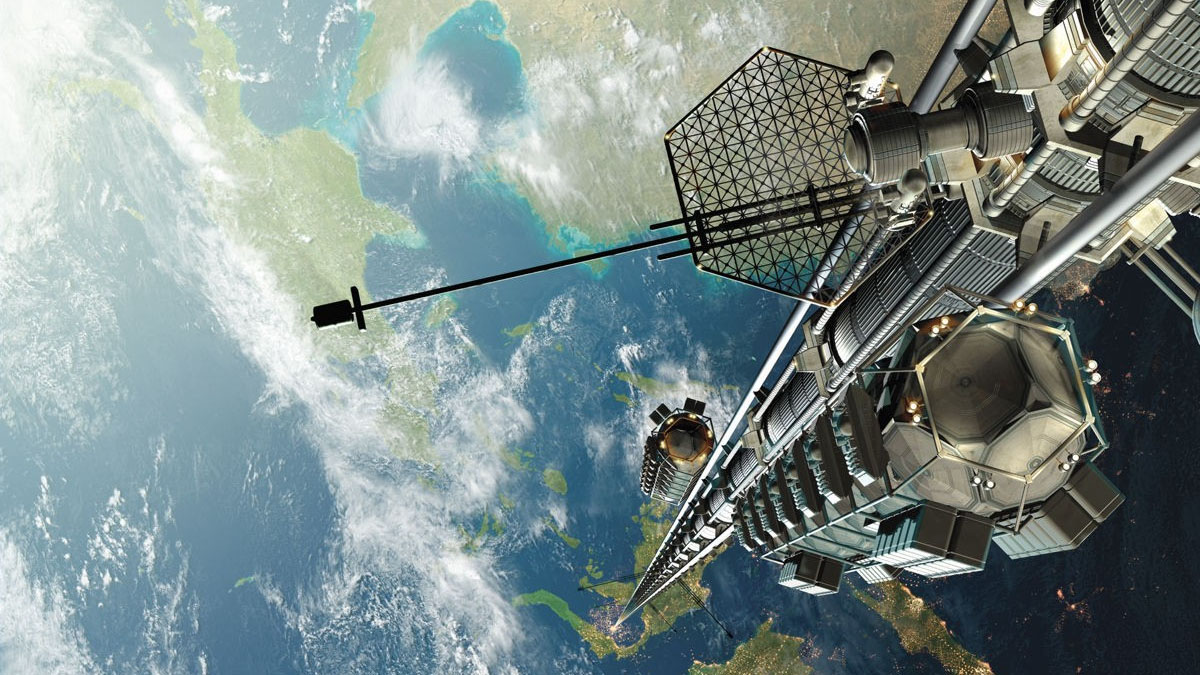
Space solar enthusiasts say they can solve this problem with space elevator technology. By manufacturing a cable long enough to stretch a little more than halfway across the Earth and tying one of the ends to a rocket with a satellite to be placed in geosynchronous orbit, this taught cable could be used almost like a wire to get electricity flowing directly to Earth. Diffusion? What diffusion? It would just be a giant plug into a solar array in constant view of the Sun. Aside from the challenge of actually launching a giant tether into space and having it survive both the takeoff and climb to orbit without being ripped out of its housing or crashing the rocket into an ocean like a hammer driving a nail into drywall, this sort of setup would probably light up the eyes of an enemy general planning an attack. Even better for him if you combine the tether’s function as a power supply with its intended use as a space elevator which launches satellites into lower orbits. A volley with kinetic impactors would not only send entire regions into rolling blackouts, but also deal a blow to your spaceflight capabilities. And as the pieces fall from orbit, nothing good will happen when they land.
Oh and I should mention that a climb to orbit is not vertical but instead, the flight path is more of a curve. That’s why companies and governments want to launch rockets as close to the equator as possible, to use some of the angular momentum of the Earth’s spinning equator to accelerate the rocket into space. To have a big and very heavy tether along for the ride would be a major problem because it would either have to be big enough to warp around the planet during the climb to orbit, or packed into the rocket itself. Although how would you fold a 22,000 mile cable that would exceed the payload capacity of today’s most powerful launch vehicles, even if it’s built from carbon nanotubes? The only vehicle that could conceivably do the job is the long decommissioned Saturn V rocket and even then, it would be a major challenge. We would also need to figure out how we would anchor a cable stretched by a satellite moving at 6,876 miles per hour and in which the tolerance for a change in trajectory caused by the planet’s gravitational field is extremely, extremely small.
All in all, the idea of space solar looks plausible but totally impractical. We would be much better off building a new generation of better photovoltaic panels and deploy them across entire nations, or in vast solar arrays in deserts like we’re trying to do now. That will let us harness more of the Sun’s power without building the 21st century rendition of the Tower of Babel which could be a lot more trouble than its worth.