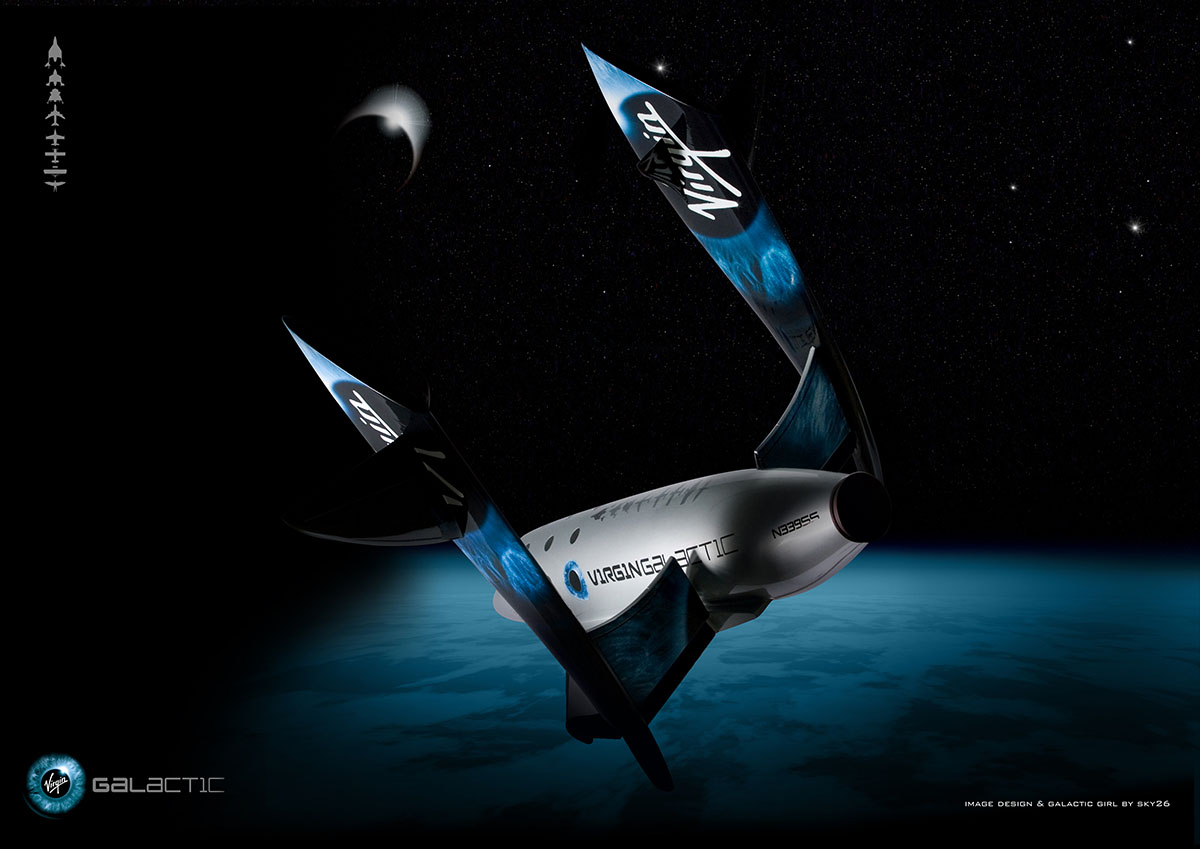
behold the shape of things to come. hopefully…

After years of secrecy and bold talk from Richard Branson, the first commercial spacecraft for sub-orbital flight and its carrier craft have been unveiled to the public. SpaceShipTwo is the size of a large cabin private jet and will accelerate to 2,600 mph with its hybrid rocket motor, reaching a maximum altitude of 68 miles. Hundreds of aspiring space tourists have lined up for the $200,000 tickets so far and the spacecraft is scheduled to take its first paying customers above the Karman line sometime in 2011. It seems that the future has finally arrived.

Should SpaceShipTwo succeed, it will be followed by an orbital craft which could take space tourists to orbital hotels and take us one step close to single stage to orbit flight (SSTO) and by then, space travel should be far more affordable since the spacecraft will have a chance to pay for themselves, be entirely reusable, and made in bulk to achieve economies of scale. An even better upside is the amount of jobs that will be needed to keep the space tourism industry going once it becomes profitable. Virgin Galactic says that some 12,500 jobs have already been created by space tourism start-ups, and considering who’s being hired, many of them are the very kind of science and engineering jobs the U.S. desperately needs to stay ahead in global R&D.
If space tourism proves to be a big, viable business with applications in entertainment, commerce, and work carried out by space agencies, it could provide a slow and steady expansion in high tech occupations and the economy at large. I sincerely hope the space tourism business works out better than the wildest dreams of all the rocketeers building suborbital spacecraft and planning space hotels. Trying to explore space and to build a business which encourages our sense of wonder, excitement and exploration, is an admirable goal and it’s one of those concepts which rewards those who really want to do something noble and inspiring for humanity with cold, hard cash. And it just doesn’t get any better than that…





NASA is the FEMA of ground to orbit. Branson teamed with Rutan into a Skunkworks of the best and brighest pursuing product not process. When Virgin Luna is continuously inhabited, Branson is a Head of State by international legal precedents dating back to at least the early 1500′s. That’s even better parking than a handicapped sticker.
Ah, but according to the 1967 Outer Space Treaty, there’s no way to claim any sort of legal possession of the Moon. It’s true that Branson does have plans to eventually open his own lunar base and of all the people in the world, I think he’s the one with the ambition and the raw cash to do it. But will he actually own a piece of the Moon? That’s going to be a messy legal battle.
Personally, I’m all for private ownership of pieces of other worlds. For what we want to do, there needs to be a very clear legal framework for who owns what and what they’re allowed to do there.
If the price comes down in a few years (decades?), this could become a serious problem for climate change. I imagine these craft will be serious polluters.
How much commercial spacecraft would contribute to pollution will depend on how exactly their propulsion systems will work. Sure, they’ll add to carbon emissions but I doubt that the prices will come down so much, carbon emissions from orbital trips will be on par with planes and cars.
Those will be far greater polluters with sheer numbers and frequency of use. Millions fly and drive every day. Spaceflight will be much rarer for a very, very long time simply because of its nature.
One problem with trying to control our carbon footprint is reaching a balance so we do the least harm but don’t go overboard and worry so much about how green new technology will be, we stifle innovation. It’s much harder to make a green rocket than a green car or a greener airplane. Luckily, if we tackle the planes and cars, we could minimize the impact from the rockets.
…will he actually own a piece of the Moon? That’s going to be a messy legal battle.
Yes, I concur.
But like you said, as private space companies make space travel in of itself more ubiquitous, especially Lunar tourism or mining concerns, this issue will no doubt have to be settled, no two ways about it.
Of course we’re talking decades down the road, but it’s going to happen regardless, especially if individuals like Branson, Beeson, Bigelow and Musk have a dream and throw their billions into the initial investment.
Somewhere in a parallel universe, Robert Heinlein is smiling knowingly.
Re: Rocket pollution.
It turns out that if you added the total amount of carbon emissions from the last 23 years of NASA shuttle launches (there’s been over 130) and added it to the total amount of US car emissions for the same period, NASA will have contributed 0.0003% of the total carbon dioxide emission budget.*
What’s more, the shuttle isn’t considered “eco-friendly” either. Commercial launches are far more efficient, smaller and — as said by Branson over and over again — they can be considered to be “environmentally benign.”
So no, unless commercial spaceflight opened up hundreds of spaceports around the globe, all serving hundreds of flights a day, I’d say that even then, they wont be able to compete with the automobile or aircraft industries for carbon dioxide production. And even then, where are all these hundreds/thousands of space launches going? Nope, something of this scale isn’t probable until we’ve gotten our bums off this rock and colonized the solar system… and by the time this happens, I seriously doubt carbon emissions will be an issue.
* Oh No! Rocket Launches Are Bad for the Environment? We’d Better Stay at Home Then.