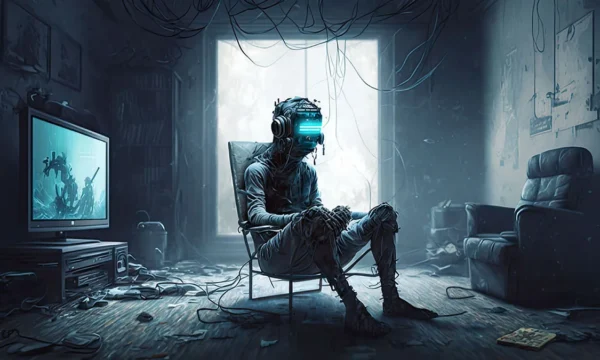
why plastic eating bacteria are our best hope and worst enemy
We've made an awful lot of plastic, and it's a global ecological disaster. Now, bacteria that can eat it might be our best bet to get rid of it. At a steep price.

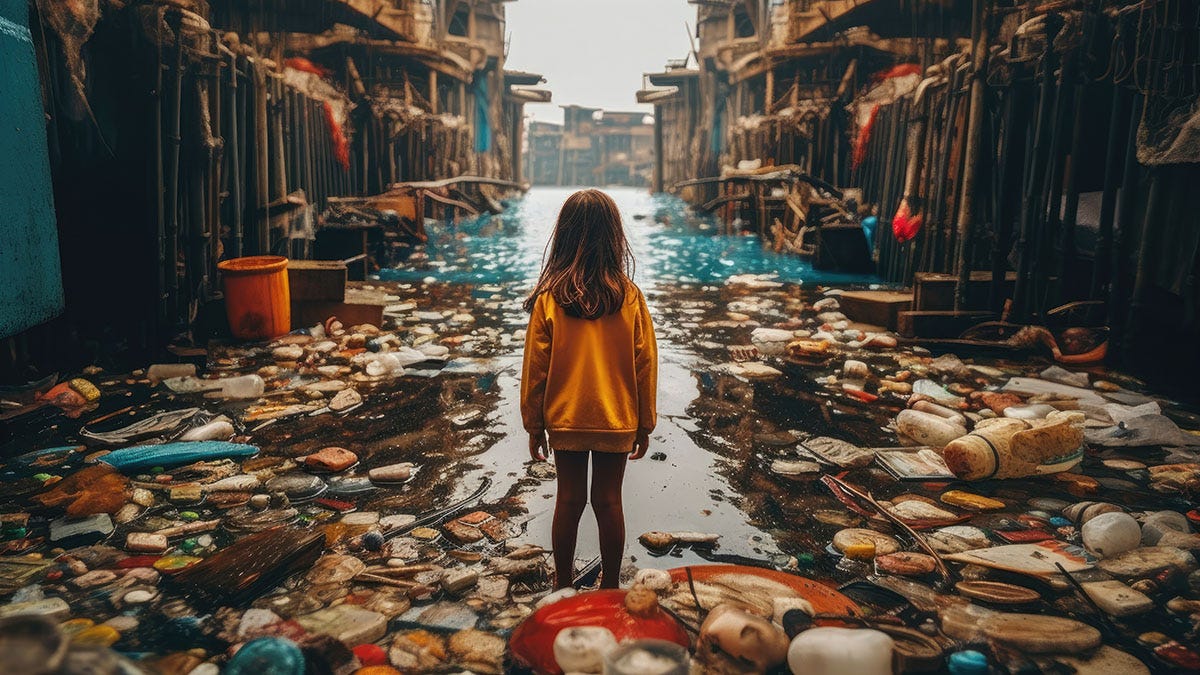
A woman in a grocery store selects a fish from a display. The worker weighs the fish, prints out a barcode, and hands it to the customer. Can I have a plastic bag for this? the customer asks. Already inside, smiles the worker. Roll the ba-dum-tiss and laugh track. Very funny. A classic comedy, right? Well, actually, no because this isn’t just a stupid joke but our very stupid reality. We make almost 400 million tons of plastic in a typical year and are on pace to break a billion tons in the next four decades. We also don’t recycle more than 9% of it despite promises from companies that make and use it in all aspects of their packaging and design. At this point, it’s floating in our oceans, buried in our landfills, and even swimming around in our blood and organs.
Enter a discovery by a team of Japanese scientists who found bacteria which happily munched on a type of plastic called polyethylene terephthalate, or PET. It seems that the abundance of plastics has created bacteria which can metabolize them. Pop sci headlines hailed this discovery as the beginning of the end for our plastics problem, and scientists rushed to create ways to do the same thing at industrial scales without unleashing organisms that would eat and corrupt plastics we actually have to use, and for which we currently have no good alternatives. (The last thing you want is microbes eating plastic pouches of medicine and donor blood in hospitals.)
After years of hard work learning how to extract the enzymes used by the bacteria in question, companies in France are now using them to efficiently recycle PET. So, the problem is finally solved and all we need to do is ramp up this process, right? Well, no, not quite. PET is fairly ubiquitous and found in everything from water bottles, to single serve packaging, to clothing, but only makes up 10% of all plastic manufacturing and half of all plastic waste. Likewise, PET is the easiest type of plastic to recycle already, and adding enzymes to turn it into precursors instead of pellets is expensive, comes with toxic byproducts to be stringently deal with, and needs government support.
It also leaves us with the quandary of what to do with half of all waste we don’t seem to be able to target yet, and 90% of the plastics being manufactured. Surely, we need to find more plastic-eating bacteria and harness their enzymes, which we have been trying to do. However, there’s skepticism over how many plastics can actually ever be properly digested and broken down. Nylon and polyurethanes seem like the promising candidates, but that’s less than a quarter of all plastic types. The rest may just be way too difficult to break down in forms that would ever be useful again and allow us to do what we do with glass and metals, keeping them out of landfills and water.
Furthermore, there’s the question of whether we’d even want to keep recycling plastic instead of finding new materials for places where they’re needed. Maybe it would be a lot wiser to use metals, glass, and compostables typically made of corn husks, fibers, and cobs, as often as we can. Close to half of all plastics are used for single serve and disposable containers, so that would contribute hugely to a reduction of new waste. Likewise, there’s the threat that bacteria will either eventually grow to eat all plastics on their own, through natural selection, or engineered microbes meant for a recycling facility using their digestive enzymes get out and wreak havoc as they multiply.
The more we try to experiment with such microbes, the more chances we’re giving to something to exploit an ecological niche we created by churning out well over 8 billion tons of plastics since the material’s inception. A naturally evolved species of bacteria, or one that hitches a ride on a latex glove to a plastic water bottle of a lab tech, then a car’s cupholder, and so on, and so forth, would be looking forward to feasting on half of Mount Everest worth of potential food with very little competition. That sounds like a great thing for the environment, but very problematic for us because plastics are in everything from safety devices, to planes, to trains, to computers.
And this is why cleaning up plastic is such a complicated problem. We made way, way too much of it. It’s too durable to break down on its own in less than centuries at best and eons at worst. We recycle far too little of it, and even then, we could only recycle it a few times before it’s useless microscopic dust that gets into living things. And on top of all that, our best hope to ever get it under control could backfire on us and end up eating the plastics we use for every convenience of modern life, even clothing. But if we don’t make eliminating plastic waste and transitioning to more environmentally friendly materials a top priority, things are only going to get worse and more toxic.
See: Yoshida, S. et al. (2016) A bacterium that degrades and assimilates polyethylene terephthalate, Science 351, 1196-1199 DOI: 10.1126/science.aad6359
Wei, R., Tiso, T. et al. (2020) Possibilities and limitations of biotechnological plastic degradation and recycling. Nat Catal 3, 867–871 DOI: 10.1038/s41929-020-00521-w