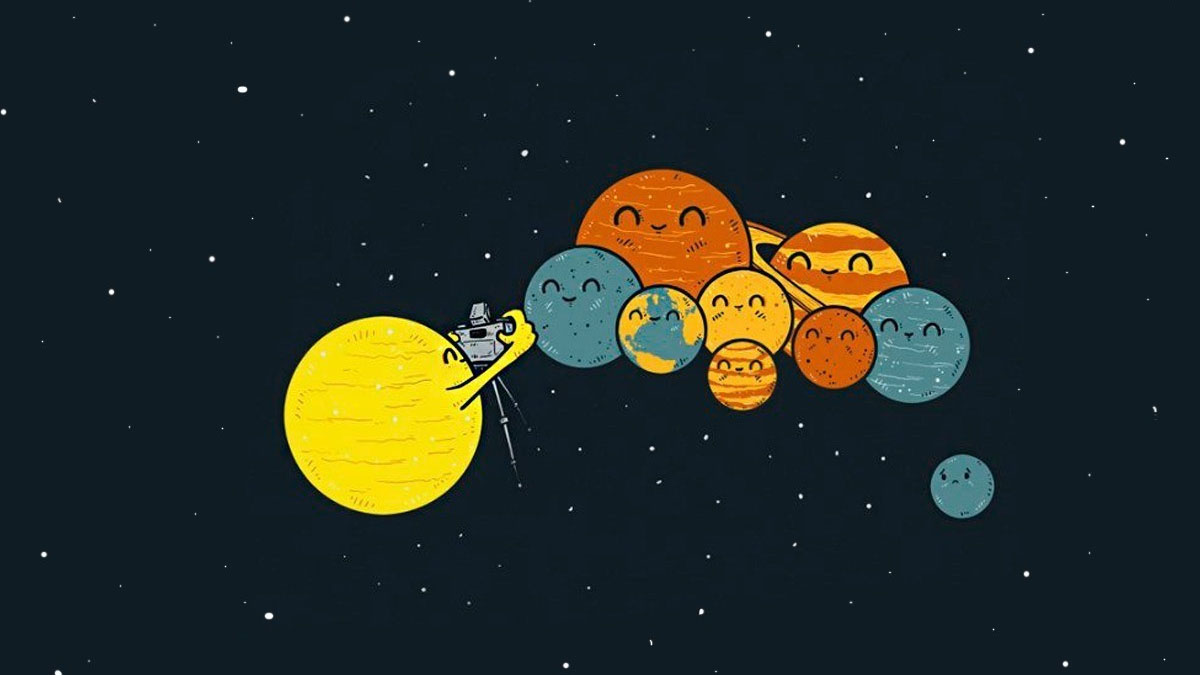
don't forget to blame a scientist…
Generally, when you walk down the street and see a man shouting about conspiracy theories on a soapbox a few steps from a court house, you don’t expect to see a police officer handing him a bullhorn and clapping as he makes a particularly heated statement. And yet, I saw an analogous situation in Chris Mooney’s and Sheril Kirshenbaum’s new book, Unscientific America. Rather than start with the state of the nation’s schools or the false controversies damaging science education and literacy, their prime example of the giant rift between the scientific community and the public is the demotion of Pluto after the discovery of Eris and Sedna. Huh?

The funny thing is that while quoting the reasons given by the IAU for the planet’s reclassification, they still say it could’ve been left a planet and quote critics while demanding to know just how scientists could’ve failed to anticipate the bizarre public outcry that followed. Mooney is a science writer and Kirshenbaum is a biologist. I would think both of them should be familiar with the fact that science is a dynamic structure and when a new discovery comes along, it could overthrow century old ideas. This is the point I try to drive home on this blog at least once a week when explaining how the scientific process works. Get enough evidence and you can pretty much overturn anything you want. The same thing happened with Pluto.
Sure, its orbit was always eccentric and very unusual compared to the other planets in the solar system, but a strange orbit isn’t necessarily a reason not to call it a planet. We know from looking at alien stars that planets can have very erratic orbits on a fairly constant basis. But at the time when we called Pluto a planet, it was the only spherical, rocky object out there. We thought it was unique. However, it turns out that the Kuiper Belt also hosts over a dozen other spherical and large objects with similar orbits. It’s not unique after all and it floats in the haze of other small rocky, icy bodies rather than dominates an orbit around the Sun like say, Earth which is the most gravitationally powerful object 1AU from its star. The suggestion that we could’ve just tacked on a few more planets not to offend Pluto’s sensitivities borders on blatantly unscientific. In reality, we would’ve ended up with potentially hundreds of new planets which we weren’t sure are planets at all.
If anything, the debate over Pluto raised questions about what a planet actually is and the IAU came to a huge realization that no one actually bothered to define exactly what a planet was until then. As astronomers tried to figure it out, there was no way they could know that the public would get so riled up over a bit of rock and ice so far away, even Hubble is powerless to image it as anything more than a fuzzy ball with hazy streaks. This was the outrage of people who grew up with a memorization of science, not a flexible view of it and they were mad that something they learned in school was being challenged or taken away. To them, science was a fact list, like the answer cards to a trivia game. That someone would come up, take a look at the card and say “oh, this one’s wrong” was cheating in their minds. And when people get riled up, they often don’t care about what you tell them or how you explain the change. They want to vent first, then maybe they’ll think about listening.
Rather than see this is a revealing glimpse into the dynamic nature of science and a symptom of the problem in science education standards in our schools, Mooney and Kirshenbaum use it to turn the criticism around, put scientists against the wall and demand an explanation for why they didn’t explain things better. They tried to explain the problem very well if you were paying attention. For example, Neil deGrasse Tyson always does a phenomenal job of providing easily digestible notes on complex phenomena and he was very vocal during all the commotion. It was his explanation that got me looking back over my astronomy notes and concluding that the reasoning behind the demotion was perfectly sound in my mind. But I was willing to listen and ask why an object which was classified as a planet for so long be demoted, not just angry about eggheads messing with my textbooks and snarking about what they’re going to change next.
Funny enough, when someone tries to raise the problem that explanations from scientists also require public intent to listen to the explanations being provided in response to Mooney’s remarks or on his blog, that person is immediately accused of turning on the public and being disrespectful of their views. The fact remains that a crazed zealot who thinks that scientists are the spawn of Satan and evolution is a demonic doctrine Darwin’s ancestors found in a haunted forest, doesn’t care about explanations and evidence. Blaming scientists for his delusions is counter-productive and seems to be more of a populist appeasement tactic than anything else. Science writers need to have the constitution to give the public a bittersweet pill in debates about the state of science education in the U.S. Sure, the scientists can always do a better job of explaining their research and what it means but the public needs to be willing to listen and limit the damage done by people who care only about dismantling science and public schooling to validate their personal delusions. Communication needs to be a two-way road, not an exercise in talking past people who frankly don’t give a damn about what they’re being told by those with who they disagree.






Americans like nothing better than to root for the underdog. Picking on poor little Pluto – the very idea. Which was exactly the idea behind the cartoon. It even made me say Awwwww. Very few people live on Planet Science.
Pluto is still a planet. Only four percent of the IAU voted on the controversial demotion, and most are not planetary scientists. Their decision was immediately opposed in a formal petition by hundreds of professional astronomers led by Dr. Alan Stern, Principal Investigator of NASAs New Horizons mission to Pluto. One reason the IAU definition makes no sense is it says dwarf planets are not planets at all! That is like saying a grizzly bear is not a bear, and it is inconsistent with the use of the term dwarf in astronomy, where dwarf stars are still stars, and dwarf galaxies are still galaxies. Also, the IAU definition classifies objects solely by where they are while ignoring what they are. If Earth were in Plutos orbit, according to the IAU definition, it would not be a planet either. A definition that takes the same object and makes it a planet in one location and not a planet in another is essentially useless. Pluto is a planet because it is spherical, meaning it is large enough to be pulled into a round shape by its own gravity–a state known as hydrostatic equilibrium and characteristic of planets, not of shapeless asteroids held together by chemical bonds. The other spherical objects in the Kuiper Belt are planets as well.
These reasons are why many astronomers, lay people, and educators are either ignoring the demotion entirely or working to get it overturned. I am a writer and amateur astronomer and proud to be one of these people. You can read more about why Pluto is a planet and worldwide efforts to overturn the demotion on my Pluto Blog at http://laurele.livejournal.com
Petition of astronomers who rejected the demotion: http://www.ipetitions.com/petition/planetprotest/
Audio transcripts of the Great Planet Debate, held at the Johns Hopkins University Applied Physics Lab in August 2008: http://gpd.jhuapl.edu/
I’d heard about this but had no idea it had everyone so riled up. We’ve had to let go of old ideas so often along the way you’d think it’d be accepted as only natural that there will be more discoveries that shift things around…it would be sad/strange if there weren’t! Bring it on! Thank God we’ve moved past torturing and killing scientists who shake up our boundaries, comfort zones, and old ideas!
I am kind of glad it caused a stink though, cause I love the cartoon!
What I can’t get over on the Pluto fiasco is that it seems that the argument for demotion is purely organizational and not particularly scientific in the least. As Laurel points out, there is an objective differential between planets and smaller bodies, i.e. whether it’s big enough to have enough mass to pull itself into a stable sphere. This line is appealing to a layman also because it makes a sort of sense: the round things are planets, the smaller chunky things are asteroids/debris/etc.
The core argument for demotion seems to revolve (ha!) around it just getting so sloppy if we start including all those Kuiper objects. So they draw an extraordinarily tenuous and arbitrary line designed to include what they’ve predetermined as planets and exclude those that aren’t. Arbitrary lines of classification exist for purely organizational purposes. This argument is no different than having a brawl over whether “A” and “B” should have different folders in the filing cabinet or combined into “A/B”. The distinction exists for organizational purposes, any argument for or against should fundamentally be about the organizational merits of one choice or another.
We’ve got four terrestrial planets that are completely different from four gas giants which are of course completely different from the outer Kuiper objects. But they’re all planets according to the fairly logical original definition. I fail to see why a group of scientists has decided to declare war to re-organize things so arbitrarily. It’s just … unscientific.
Steven Lloyd Wilson:
What you don’t seem to see is the the moniker ‘planet’ is itself purely organizational and arbitrary. We’re talking about nomenclature, there’s no scientific test you can do to determine if Pluto is a planet. You just define the word and see what fits the definition and what doesn’t.
And they are. ‘Planet’ never had a formal definition, now it does. And the IAU decided the most useful definition was one which excluded Pluto.
Nobody ever said you weren’t allowed to call Pluto a planet anymore. The word ‘planet’ has a strict technical meaning (excluding Pluto) and a colloquial meaning (including Pluto). This is not uncommon. Nobody cares if you call Pluto a planet colloquially. I do so myself. I even refer to our Moon and other large moons as ‘planets’ in certain contexts. Which, by the way:
You seem to forget about all the large moons… There is a continuum from small objects to large ones, celestial bodies don’t come in discrete masses. No matter where you draw the ‘planet line’ it’s going to be artifical. The only thing that’s changed is someone has finally drawn that line instead of leaving it ill-defined and fuzzy.
You can call Pluto a fizzgig if you want, it doesn’t change a thing. It’s just semantics.
Good explanation, and I think that the larger point you are making about public engagement is a good one. I think I should read this book as soon as I get the chance because I have read the criticisms and reviews, and am inclined to dismiss it based on them.
The problem as I see it, is not one of scientists’ abilities to communicate, but the willingness of the public to engage and listen. I don’t think that this is a new one, and I don’t think that there was a magical time in history in which the general public was any more engaged (except perhaps during the space race of the 1960′s. Then, the threat seemed more real as the battle between the Soviets and the US to gain control of the space around Earth was real and urgent.
I think that our society has far too many distractions available to which people are more willing to turn to than to engage in learning about science. That is, except for those already interested. It’s harder to get people to listen to the issues on global warming because climatology is so complex, and we can be easily misdirected by the denialists because they use such scientific language.
Consider that we now have hundreds of cable channels filled with intellectually unchallenging content, stuff that one need only lay back and enjoy without having to put forth effort; and combine that with the fact that so many people are stressed by life itself that they are probably just needing to tune out when the thinking gets tough. When Matthew Nisbet and Chris Mooney toured to introduce “Framing Science” at the universities and colleges, they came to Minnesota and I listened with interest to what they had to say. The problem with the framing is that it is useful in politics because framing oversimplifies issues in order to get people to hear them in a way that engages them. Political framing also distorts the message. I think that this is in large part a major reason that so many scientists resist the concept.
Of course, the next major problem with the case that they were making at the time, and Mooney and Kirshenbaum bring it back into this book, is that they misplace the blame on atheism. I honestly don’t think that for the larger audience they are trying to appeal to regarding science and issues related to science, that atheism is a major issue at all. For most people, they don’t even care about the perception nor are they even likely aware of PZ Myers, Richard Dawkins, Jerry Coyne or others who make the logical connection between science and atheism. It’s an issue that’s not on their radar.
It occurs to me that the “war” between the accommodationists and the “new atheists” is over much smaller territory than they think. It may rage over a small part of the internet, but when I mention it to co-workers I get a blank stare.
Is there not a discipline known as planetology, with professional planetologists both researching and teaching? Aren’t these persons drawn from a pool of well-educated scientists trained in systematic thinking and distrust of sloppiness? How on any orbiting body more than x kilometers in diameter could there not have been a generally accepted definition of “planet” before the second year of the second term of the second Bush maladministration?
I think the people who object so strongly to Pluto being demoted need some historical perspective. This is far from the first time the membership of the category “planet” has been adjusted. To the ancients, the Earth wasn’t a planet, but the Sun and Moon were. The category has been adjusted over time as we found out that certain bodies were more or less similar to what we had previously thought. That’s exactly what has happened with Pluto: we thought it had a level of uniqueness similar to that of Earth or Jupiter or Neptune, but now we know it doesn’t.
I think that partly this dissent is due to the disconnect between how the human mind categorises things (according to their similarity to prototypical examples, with fuzzy-bounded categories) and how science must categorise things (hard-edged categories constructed according to explicit lists of necessary and sufficient conditions).
Mooney’s and Kirshenbaum’s argument falls even flatter when you look at how the demotion of Pluto was greeted in the UK.
Like in the US the decision got a lot of media coverage here. Scientists were interviewed to explain the reasons behind the decision. I saw or heard Patrick Moore, Martin Rees, Brian May and Neil DeGrasse Tyson all interviewed about the change, and all said it was because we know now more about Pluto, and science adjusts as it finds out more.
There was no public outcry over the demotion in the UK. That could be because the scientists interviewed in the UK were better at explaining it. I doubt that it is the case, and anyway the same scientists would be available for interview by US media outlets. It would seem that in the US science journalists did not do a very good job. Given Mooney is a science journalist one could understand why he would be a bit sensitive about that.