wait, can planets reproduce by budding?

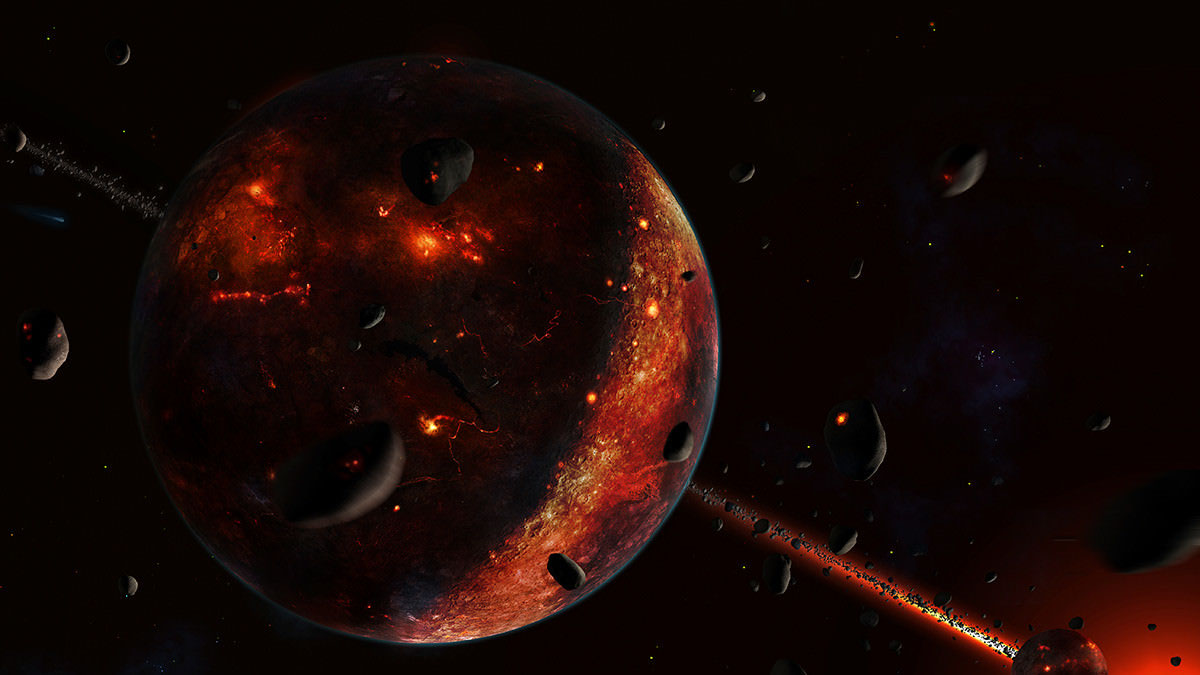
Well, according to a paper by a physicist and a geologist who propose that a bubble of molten heavy metals was ejected from a young Earth after a nuclear meltdown within its innards and formed the Moon, they could. Forget the notion of a wandering world plowing into our planet and ejecting the material which would become our natural satellite, even though we have evidence that collisions happen in young solar systems. Imagine a spheroid of molten rock wildly spinning around its axis. As molten uranium and thorium churn close to what would be its equatorial plane, they trigger a runaway nuclear reaction until a planetary meltdown belches out a plume which cools into the Moon. Okay, I’m sure they have a reason to reject the mainstream consensus…
Let’s think back to the impact theory. When an object delivers a glancing blow to the young Earth, it sends our planet whirling around its axis, and as it does, a spray of superheated rock is shot where the Moon will form. But apparently, there’s a problem with this scenario and for the authors, the proposed solution to this problem just isn’t good enough, which is why they resurrected the fission spin-off hypothesis from its slumber. Models suggest that around 80% of the Moon’s make up should’ve come from the impacting planet. However, it has a lot more in common with the Earth in terms of composition. The current explanation is the mixing of the rocks right after the impact, while the proto-Moon was still molten and coalescing. But to Rob de Meijer and Wim van Westrenen, this seems a little too convenient. Instead, they argue that the chances of a close match between our planet and an alien world at the dawn of the solar system is highly unlikely, especially in the levels of such heavy elements as uranium, chromium, neodymium and tungsten.
Now, having the Moon spun out of a proto-Earth would account for the similarity in their composition, but you’d need a rather bizarre arrangement for this to happen. Our young planet would need to be very distorted, twice as wide around its equator as it would be around its poles. A day on this planet would be only 2 hours and 18 minutes long. There doesn’t seem to be any proof this would happen and the only supporting evidence used by de Meijer and van Westrenen is math showing the energy and momentum of their hypothetical early Earth and the newly formed two body system, and the similarities between rocks on the Moon and Earth rock with a few traces of the key elements they say will clinch the case. Well, assuming of course that planets in a similar range of orbits can’t form from very similar elements and have a similar composition that could mix in the kind of blast thought to have created the Moon, a concept that’s oddly missing from their paper.
And that’s the big problem with de Meijer and van Westrenen’s proposal. It seems very over-thought and uses a 150 year old idea formed when we had no proof of planetary collisions instead of trying to work out if planets coalescing from similar materials could have a similar composition and to what degree before slamming on the brakes and starting from scratch on a proposal that would be incredibly difficult to prove. And considering that we already have an example of planetary collisions, it seems like an awfully big step back to reconsider a concept from the Victorian era just to start the whole scientific process from scratch…
See: R. de Meijer, & W. van Westrenen (2010). An alternative hypothesis for the origin of the Moon, submitted to Earth, Moon and Planets arXiv: 1001.4243v1